
- About Us
- Products
- Suprakare
- Analgesic &
Anti-inflammatory - Analgesic & Antipyretic
- Antibiotics
- Anti-emetic
- Anti-ulcerant
- Prokinetic
- Laxative
- Pre-Probiotic
- Topical Antibotic
- Hepatoprotective
- Nutrakare
- Haematinic
- Anti-Infertility
- Anti-Cold
- Anti-diarrhoeal
- Antibiotic
- Prokinetic
- Calcium Supplement
- Digestive Enzyme
- Pre-Probiotic
- Menstrual Cycle Regulators
- Vazokare
- Anti-hypertensive
- Anti-anginal
- Lipid lowering agent
- Anti-diabetic
- Drugs for neuropathy
- Drugs to prevent
Vascular Calcification
- Collaboration
- International
- R&D
- CSR
- Corporate Governance Policies
- Safety Reporting



Products

 Suprakare
 Analgesic &
Anti-inflammatory- Analgesic & Antipyretic
- Antibiotics
- Anti-emetic
- Anti-ulcerant
- Prokinetic
- Laxative
- Pre-Probiotic
- Topical Antibotic
- Hepatoprotective
...................................................................
- Haematinic
- Anti-Infertility
- Anti-Cold
- Anti-diarrhoeal
- Antibiotic
- Prokinetic
- Calcium Supplement
- Digestive Enzyme
- Pre-Probiotic
- Menstrual Cycle Regulators
...................................................................
- Anti-hypertensive
- Anti-anginal
- Lipid lowering agent
- Anti-diabetic
- Drugs for neuropathy
- Drugs to prevent
Vascular Calcification
...................................................................
...................................................................
- Analgesic &
Anti-inflammatory - Antibotics
- Anti-Cold
- Anti-Osteoporotic
- Hepatoprotective
- Muscle Relaxant
...................................................................
...................................................................
...................................................................
...................................................................
...................................................................

Vazokare
Anti-Diabetic
Gepride 1 MG

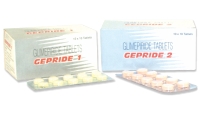
Description
Glimepiride blocks potassium channels on the β cells of pancreas. Thus releases insulin. In addition it also has an extra pancreatic activity. Besides releasing insulin, glimepiride by itself improves the sensitivity of the insulin receptor and thus improves blood glucose control. Glimepiride has certain valuable advantages over other sulphonylureas like; Glimeperide causes insulin release in the same phases as that of natural pattern of insulin release. Thus, there is no continuous release of insulin, hence there are very less chances of hypoglycemia. Unlike other sulphonylurea, glimeperide improves or contributes to overcome insulin resistance (extra pancreatic action). This improves insulin sensitivity.
Indications
Type-2 diabetes (NIDDM)
Composition
Each tablet contains:
Glimepiride
1 mg
Dosage
One tablet once daily.
Side Effects
The most common adverse effects noted were dizziness, headache, nausea.
Contraindication
Hypersensitivity to Glimepiride
Presentation
GEPRIDE 1MG TABLET is available as a strip of 10 tablets
Gepride 2MG TAB
Description
Glimepiride blocks potassium channels on the β cells of pancreas. Thus releases insulin. In addition it also has an extra pancreatic activity. Besides releasing insulin, glimepiride by itself improves the sensitivity of the insulin receptor and thus improves blood glucose control. Glimepiride has certain valuable advantages over other sulphonylureas like; Glimeperide causes insulin release in the same phases as that of natural pattern of insulin release. Thus, there is no continuous release of insulin, hence there are very less chances of hypoglycemia. Unlike other sulphonylurea, glimeperide improves or contributes to overcome insulin resistance (extra pancreatic action). This improves insulin sensitivity.
Indications
Type-2 diabetes (NIDDM)
Composition
Each tablet contains:
Glimepiride
2 mg
Dosage
One tablet once daily.
Side Effects
The most common adverse effects noted were dizziness, headache, nausea.
Contraindication
Hypersensitivity to Glimepiride
Presentation
GEPRIDE 2MG TABLET is available as a strip of 10 tablets
Gepride M1
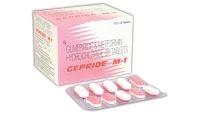
Description
Glimepiride stimulates insulin release from pancreatic beta cells. It increases the effect of insulin by enhancing sensitivity and efficacy of insulin. Metformin has the potential advantage of decreasing insulin resistance and can be used as first line therapy in combination with sulphonylurea. Studies have shown that addition of metformin to sulphonylurea treated patients with inadequate glycemic control is associated with improved glycemic control, lower post prandial insulin and triglyceride concentration and improved dyslipidemia. All of these changes to decrease risk of coronary heart diseases Metformin in this combination are in sustained release form. This eliminates multiple dosing pattern of metformin and can be given once daily.
Indications
Type 2 diabetes (NIDDM)
Composition
Each tablet contains:
Glimepiride
1 mg
Metformin (SR)
500 mg
Dosage
One tablet once a day
Side Effects
Common adverse effects include dizziness, asthenia (generalized weakness), headache, nausea and hypoglycemia.
Presentation
GEPRIDE M1 TABLET is available as a strip of 10 tablets
Gepride M2
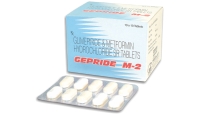
Description
Glimepiride stimulates insulin release from pancreatic beta cells. It increases the effect of insulin by enhancing sensitivity and efficacy of insulin. Metformin has the potential advantage of decreasing insulin resistance and can be used as first line therapy in combination with sulphonylurea. Studies have shown that addition of metformin to sulphonylurea treated patients with inadequate glycemic control is associated with improved glycemic control, lower post prandial insulin and triglyceride concentration and improved dyslipidemia. All of these changes to decrease risk of coronary heart diseases Metformin in this combination are in sustained release form. This eliminates multiple dosing pattern of metformin and can be given once daily.
Indications
Type 2 diabetes (NIDDM)
Composition
Each tablet contains:
Glimepiride
2 mg
Metformin (SR)
500 mg
Dosage
One tablet once a day
Side Effects
Common adverse effects include dizziness, asthenia (generalized weakness), headache, nausea and hypoglycemia.
Presentation
GEPRIDE M2 TABLET is available as a strip of 10 tablets
Gepride M3
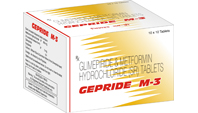
Description
Glimepiride stimulates insulin release from pancreatic beta cells. It increases the effect of insulin by enhancing sensitivity and efficacy of insulin. Metformin has the potential advantage of decreasing insulin resistance and can be used as first line therapy in combination with sulphonylurea. Studies have shown that addition of metformin to sulphonylurea treated patients with inadequate glycemic control is associated with improved glycemic control, lower post prandial insulin and triglyceride concentration and improved dyslipidemia. All of these changes to decrease risk of coronary heart diseases Metformin in this combination are in sustained release form. This eliminates multiple dosing pattern of metformin and can be given once daily.
Indications
Type 2 diabetes (NIDDM)
Composition
Each tablet contains:
Glimepiride
3 mg
Metformin Hydrochloride(SR)
850 mg
Dosage
One tablet once a day
Side Effects
Common adverse effects include dizziness, asthenia (generalized weakness), headache, nausea and hypoglycemia.
Presentation
GEPRIDE M3 TABLET is available as a strip of 10 tablets
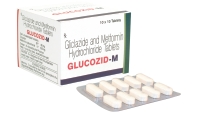
Glucozid M
Description
Glucozid is the most beneficial oral antidiabetic agent belonging to the class of sulfonylureas. Glucozid achieves better glucose control, has lower incidence of secondary failure rates, lesser hypoglycemic events and potential free radical scavenging activity.
Indications
NIDDM when dietary modification has failed
Composition
Each tablet contains:
Gliclazide
80mg
Dosage
Treatment is started with a dose of 40-80 mg/day just before meal o.d, increasing by 40 or 80 mg every few days if necessary to a max. of 320 mg. More than 160 mg is given as b.i.d dose. The treatment should begin with low doses in patients with renal and/or hepatic impairment.
Contraindication
Insulin dependent diabetes mellitus, Pregnancy, Severe renal insufficiency, Hepatic impairment, Thyroid impairment.
Side effects
Hypoglycemia, headache, gastrointestinal upsets, nausea and dizziness has been reported and skin reactions, including rash, pruritis, erythema may occur.
Presentation
Glucozid is available as a strip of 10 tablets.
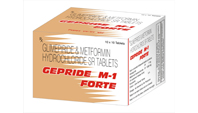
Gepride M1 FORTE
Description
This is a combination of two oral antidiabetic which works by two different mechanisms. Improves glycemic control in patients not adequately controlled with monotherapy, treats both the defects of diabetes mellitus i.e. deficiency of insulin secretion and increased insulin resistance.
Indications
Type-II diabetes
Composition
Each tablet contains:
Glimepiride
1 mg
Metformin Hydrochloride (SR)
1000 mg
Side Effects
Lactic acidosis, nausea, vomiting, diarrhea, and lower abdominal pain are rarely seen.
Contraindications
Hypersensitivity, Impaired renal function, Liver damage
Presentation
GEPRIDE M1 FORTE TABLET is available as a strip of 10 tablets
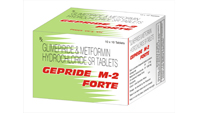
Gepride M2 FORTE
Description
This is a combination of two oral antidiabetic which works by two different mechanisms. Improves glycemic control in patients not adequately controlled with monotherapy, treats both the defects of diabetes mellitus i.e. deficiency of insulin secretion and increased insulin resistance.
Indications
Type-II diabetes
Composition
Each tablet contains:
Glimepiride
2 mg
Metformin (SR)
1000 mg
Side Effects
Lactic acidosis, nausea, vomiting, diarrhea, and lower abdominal pain are rarely seen.
Contraindications
Hypersensitivity, Impaired renal function, Liver damage
Presentation
GEPRIDE M2 FORTE TABLET is available as a strip of 10 tablets
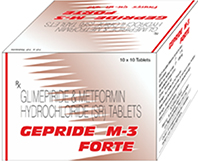
Gepride M 3 Forte tablet
|
Composition
Each tablet contains:
Metformin SR 1000 mg Glimepiride 3 mg Indications
Type II Diabetes (NIDDM)
Presentation
GEPRIDE M3 FORTE is available as a strip of 10 tablets
|
 |
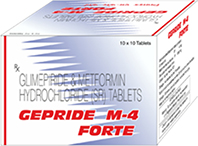
Gepride M 4 Forte tablet
|
Composition
Each tablet contains:
Metformin SR 1000 mg Glimepiride 4 mg Indications
Type II Diabetes (NIDDM)
Presentation
GEPRIDE M4 FORTE is available as a strip of 10 tablets
|
 |
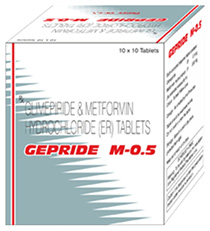
Gepride M 0.5 tablet
|
Composition
Each tablet contains:
Metformin SR 500 mg Glimepiride 0.5 mg Indications
Type II Diabetes (NIDDM)
Presentation
Gepride M 0.5 is available as a strip of 10 tablets
|
 |
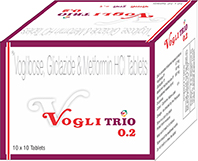
Vogli Trio 0.2 tablet
|
Composition
Each tablet contains:
Metformin SR 500 mg Gliclazide 80 mg Voglibose 0.2 mg Indications
Type II diabetes not controlled with dual therapy
Obese type II diabetic patients Presentation
Vogli Trio 0.2 is available as a strip of 10 tablets
|
 |
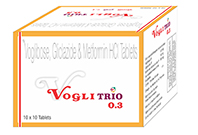
Vogli Trio 0.3 tablet
|
Composition
Each tablet contains:
Metformin SR 500 mg Gliclazide 80 mg Voglibose 0.3 mg Indications
Type II diabetes not controlled with dual therapy
Obese type II diabetic patients Presentation
Vogli Trio 0.3 is available as a strip of 10 tablets
|
 |